Tuesday, November 18, 2008

ESA blawg

For all things legal and ESA check out the ESA blawg - a legal blog that discusses the Endangered Species Act. The latest post is a good indication of the sort of material covered but there are lots of great posts there that will give you a greater legal background to some of the material we have covered. 
 
While an essential goal of the Endangered Species Act is to increase attention to the endangered and threatened species, compliance with the law also leads to unintended consequences.  The problem stems from a simple fact: increased ESA demands do not equate with increased government agency resources.  Three news stories this week highlighted the tensions between the ESA demands, and the other competing needs, priorities and duties of state agencies. 
.....
With number of ESA-listed species ever growing, and indeed, with global climate change threatening an explosion in threats to species, the absolute demands of the ESA could become increasingly difficult, or even impossible, to bear.  When that day comes (assuming it hasn't already), and in the absence of increased funding, a triage system becomes inevitable. 

Other recent posts you may find interesting - mainly because they are Californian stories:

Monday, November 17, 2008

To fish or farm?

Instead of another purely scientific shock story about how our fisheries and marine biodiversity are bound to collapse, this NYT week in review article gives a fresh fishery argument from a food critique's taste buds. In Discussion, we've debated this a bit. In short, author Mark Bittman proposes we pescavores eat cod only occasionally and sardines more frequently instead of encouraging the campaign for 'tasteless' farm-raised salmon.

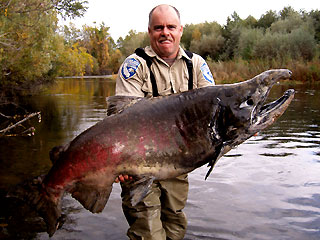
The article weighs the ecological harm from farming fish (inefficient fishmeal, excessive waste (aka poo), genetic pollution, and long term unsustainability) against the convenience of year round salmon (probably not as tasty as the 85 pd Chinook photoed below). For specific fishery trends, note the NYT side graphs and how the Northwestern Atlantic Coast Herring looks like it's doing ok, after catch restrictions were imposed. Unfortunately, the Western Atlantic bluefin tuna trend looks more dismal.

Saturday, November 15, 2008

Giant critters

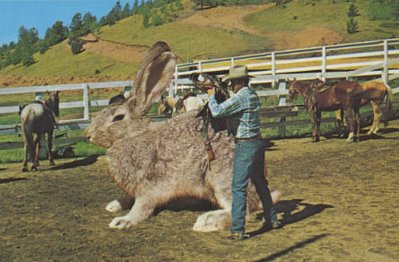
I think it's an interesting commentary on human nature that despite the absolutely incredible diversity of life (see squid photos here and here) we still want to believe in a variety of fabulous creatures that do not exist (yeti's, bigfoot, sasquatch, etc). For a while there was a brief craze of picture postcards, featuring large creatures - usually out west (see chicken below and rabbit to left). I presume this also reflected a desire to con the rubes back east.

So I was a little hesitant when I heard tale of a giant fish (hmm, I think I saw that movie) and the link was to Cryptomundo - an entertaining website that specializes in 'crytptozoology' or the study of hidden animals(like the aforementioned bigfoot). Here's the photo of an allegedly 85 lb Chinook salmon. Yeah right. Except in this case the story appears to be true. I could pretend this is relevant to class because the Chinook salmon are listed under the state and federal endangered species acts but really I was reminded of this picture by Katherine's giant chicken picture.

Friday, November 14, 2008

Genetic Integrity

I hope you're all safe from the Santa Barbara fires! I was recently up in Big Sur and it was amazing to see how much fire damage there was... Part of the natural cycle?

Anyway, as a follow up to our question in discussion about the term "genetic integrity", I found this information online: one Genetic Integrity Project strives to "protect genetic resources, the integrity of genetic material and species biodiversity". For more information on why genetic integrity is important, see this quick summary by Jayne Belnap. When the option exists, Belnap says it's best to restore ecosystems using local plants instead of non-local genetic material or non-native species to preserve genetic integrity.
Photo from http://www.berghuis.co.nz/abiator/weird/bigrooster.html

Thursday, November 13, 2008

Good news everybody

An important follow up Michael's post on George W. Bush's Last Environmental Stand. I came across this article on the Politico website and it turns out that President-elect Obama may have a much easier job than anticipated in overturning the numerous Bush administration regulations that have recently been implemented. Many of these regulations significantly weakened environmental protections - for example by allowing federal agencies to determine on their own whether their policies will threaten endangered species, rather than requiring them to go through the U.S. Fish and Wildlife Service for approval.

It could take Obama years to undo ... rules finalized more than 60 days before he takes office — the advantage the White House sought by getting them done by Nov. 1. But that strategy doesn’t account for the Congressional Review Act of 1996. The law contains a clause determining that any regulation finalized within 60 legislative days of congressional adjournment is considered to have been legally finalized on the 15th legislative day of the new Congress, likely sometime in February. Congress then has 60 days to review it and reverse it with a joint resolution that can’t be filibustered in the Senate. In other words, any regulation finalized in the last half-year of the Bush administration could be wiped out with a simple party-line vote in the Democrat-controlled Congress.

“If these rules are overturned, the benefits for the environment are potentially significant,” said Rick Melberth, director of regulatory policy at OMB Watch, a liberal regulatory watchdog group.

Wednesday, November 12, 2008

Supreme Court Says Navy Trumps Whales

Thanks to Jessica for pointing this one out.

In the first decision of the new term the Supreme Court ruled Wednesday that military training trumps protecting whales in a dispute over the Navy's use of sonar in submarine-hunting exercises off the coast of southern California.

The use of MFA sonar under realistic conditions during training exercises is clearly of the utmost importance to the Navy and the Nation. The Court does not question the importance of plaintiffs’ ecological, scientific, and recreational interests, but it concludes that the balance of equities and consideration of the overall public interest tip strongly in favor of the Navy. The determination of where the public interest lies in this case does not strike the Court as a close question.

The case was seen as a test of whether the U.S. government could sidestep some environmental restrictions on national security grounds......

Tuesday, November 11, 2008

Endangered giraffes beating the odds

Curious about giraffes? Read this Smithsonian magazine article about how the endangered Niger giraffe, Giraffa camelopardalis peralta, is surviving despite stiff competition for resources, a limited population size and one neighboring country's poaching tendencies. (Below map shows Niger, home of these giraffes, and Nigeria, where two were poached)

Sex, birth, lots of leaves, and timber collection all come into play in this well written article. If not for the drama, note how economics and conservation biology are intertwined here: by protecting the local giraffes, villagers are investing in a growing tourism industry.

Enjoy.
Photo from the Smithsonian Magazine by Jean-Patrick Suraud.

California’s Marine Life Protection Act (MLPA)

Coal Oil Point Reserve Monthly Lecture
Thursday November 20th 5:30 pm - 7:00 pm

Topic: California’s Marine Life Protection Act (MLPA)
Presenter: Michael Sheehy, Santa Barbara Channelkeeper

On Thursday, November 20th, from 5:30 pm to 7:00 pm Santa Barbara
Channelkeeper is providing an informational presentation on
California's initiative to establish a network of Marine Protected
Areas (MPAs) in Southern California. MPAs are underwater wilderness
areas that limit the extraction of marine species and aim to protect
and conserve marine life and habitats. Proposals for the designation
of these areas in Southern California will be developed over the next
year and will be greatly influenced by public input and participation.

Directions and Parking: The presentation will take place at the Cliff
House, located at Coal Oil Point Reserve in Goleta. You can find
directions to the Coal Oil Point Reserve at coaloilpoint.ucnrs.org.
Limited parking is only available in the inner parking lot (through
the gate) and anyone who parks in the outer parking lot may receive a
parking ticket. Carpooling, biking, or walking from Isla Vista with
friends is encouraged. If you plan on parking in the inner parking
lot, please arrive 30 minutes early so you will have time to check if
there is a spot available or drive to the end of Isla Vista and walk
with a friend.

Please join Michael Sheehy, Channelkeeper’s Marine Conservation
Coordinator, to learn more about California’s Marine Life Protection
Act (MLPA) and how you can get involved. For more information about
this event, please email michael@sbck.org or call 563-3377. For more
information on the MLPA Initiative and MPAs, please visit
www.dfg.ca.gov/mlpa or www.caloceans.org.

Santa Barbara Channelkeeper is a non-profit organization dedicated to
the protection and restoration of the Santa Barbara Channel and its
watersheds. As Channelkeeper’s Marine Conservation Coordinator,
Michael Sheehy communicates with and educates the public on marine
conservation efforts and issues as they pertain to the Santa Barbara
Channel, including engaging the public in the Marine Life Protection
Act Initiative process in California’s south coast region. Michael
has extensive regional knowledge of the Santa Barbara Channel’s
near-shore marine communities and scientific expertise in marine
ecology- having worked for more than eight years as a research
ecologist with the Marine Science Institute and as a project manager
with the research consortium, Partnership for Interdisciplinary
Studies of Coastal Oceans, at UCSB. Michael has also consulted for
non-profit and businesses interests, including advising on such topics
as the state of global marine resource management.

Reservations are requested. Please send Leeza Charleboix an email to
reserve a spot at the lecture.


Leeza Charleboix
Coal Oil Point Reserve
Education and Tour Program Coordinator
coprstaff@lifesci.ucsb.edu
Email: coprstaff@lifesci.ucsb.edu
Phone: (805) 893-5092

Monday, November 10, 2008

Habitat Restoration Workday at Coal Oil Point Reserve

Hello Restoration Volunteers!

Come join us Saturday,Nov 15th from 9am-12 noon for a Habitat
Restoration Workday at Coal Oil Point Reserve. Coal Oil Point Reserve
is a 170-acre nature reserve owned by UC Natural Reserve system, and
located just west of Isla Vista. The Reserve is an ecologically
important area that is home to a number of endangered and threatened
species, including the Western Snowy Plover and CA Least Tern. This
Saturday we will be improving critical habitat by planting native
species, removing non-natives, and maintaining previously planted
areas. This is a great opportunity for all community members who want
to improve water quality and the local habitat for all the critters
that live here!

If you plan to join us please RSVP to Tara Longwell at
longwell@lifesci.ucsb.edu to receive directions to our meeting spot.
Tools, gloves, water, and snacks will be provided.

Hope to see you there!
Tara Longwell
COPR Reserve Steward
http://coaloilpoint.ucnrs.org/

Glass squid

I missed this when the photo was published last year. I think it beats the piglet squid. Who knew there were so many anthropomorphic squid?

It was in a photo gallery at National Geographic. Here's the caption.

With its polka-dot mantle and cartoonish expression, this glass squid brings out a lighter side of the inky ocean deep.

Scientists found the squid and other species while mapping more than 1,500 square miles (3,900 square kilometers) of an undersea mountain range in the North Atlantic.

Until now the region had scarcely been explored because of its remoteness and depth. But the new survey shows that the ridge is teeming with life, said Monty Priede, expedition leader and director of the University of Aberdeen's Oceanlab research center.

"The Mid-Atlantic Ridge is roughly equivalent in size to the European Alps and is one of the largest areas of habitat available in the ocean," Priede said.

You can read more at the accompanying article.