Thursday, October 15, 2009

Sustainable Seas – The Vision, The Reality

TALK: Sustainable Seas – The Vision, The Reality
Sylvia Earle
Monday, October 19 / 8:00 PM
Campbell Hall UCSB
Admission $10 general / $8 student
Oceanographer and 2009 TED Prize-winner Sylvia Earle has led more than 50 expeditions worldwide involving more than 6,000 hours underwater. She has served as the chief scientist of the National Oceanic and Atmospheric Administration, and is currently an explorer-in-residence at the National Geographic Society. Now, Earle is the face behind Google Oceans, a comprehensive simulated ocean guide that explores the evolving history of the sea. Earle will share her joy of discovery through images and stories from her more than 30-year aquatic career – and express how that joy can help save the world. Books will be available for purchase and signing.
Sponsored by Arts & Lectures, the Environmental Studies Program as part of the Critical Issues in America Forum “Forty Years After the Big Spill – Looking Back, Looking Ahead: 21st Century Environmental Challenges in a Global Context,” and the IHC’s Oil + Water series.

Or you can watch her TED prize talk for free. Or maybe watch the free talk and then get inspired to go and see her in person.....

Wednesday, October 14, 2009

Multiple Allee effects and population management

(S)pecific population models of species... could help reveal how component Allee effects interact in nature. This endeavour is especially important in systems where human activity has a significant role, if sustainable development and conserved biodiversity are to remain primary goals of conservation biology.

I briefly mentioned this paper, Multiple Allee effects and population management, in class. It contains a nice review of the issue and is, I think, a good example of how ecology and conservation biology are well integrated these days

Summary
Allee effects, strongly related to the extinction vulnerability of populations and gradually becoming acknowledged by both theoretically oriented and applied ecologists, have already been shown to have important roles in the dynamics of many populations. Although not yet widely recognized, two or more Allee effects can occur simultaneously in the same population. Here, we review the evidence for multiple Allee effects and show that their interactions can take several forms, many of which are far from inconsequential. We suggest that more research is needed to assess the prevalence and interactions of multiple Allee effects, as failing to take them into account could have adverse consequences for the management of threatened or exploited populations.

Tuesday, October 13, 2009

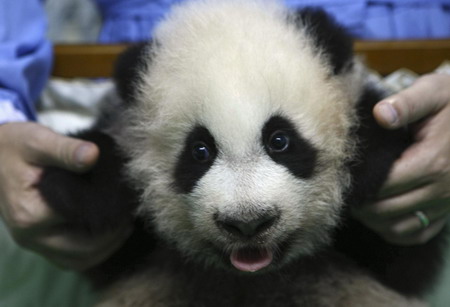
Panda insemination

How did we ever live without the internet? I now know more than I ever thought I would about artificial insemination in panda.

The bottom line is that they DO use artificial insemination now, and it's very successful. However, although China began to try artificial fertilization technologies on giant pandas in the 1960s, success was very low until quite recently. Major breakthroughs only occurred after the 1990's with nine baby pandas from artificial insemination born in 2000, 12 in 2001, 10 in 2002 and 15 in 2003.

Giant pandas show little instinctive behavior in captivity, especially sexual desire, essential for natural mating and conception. Zhang and his team have worked hard in recent years to tackle the endangered animals' breeding problems and have resorted to artificial insemination, frozen semen and even showing the pandas videos on natural mating in the wild to arouse their sexual instincts.

The somewhat clueless nature of the panda has led some to suggest that it may not be worthy of its emblematic status.

"Here's a species that, of its own accord, has gone down an evolutionary cul-de-sac," said BBC wildlife expert Chris Packham

"Unfortunately, it's big and cute and a symbol of the World Wide Fund for Nature (WWF) and we pour millions of pounds into panda conservation."

Packham, who hosts Springwatch, a popular BBC nature show, said money spent trying to save the panda would be better invested in helping other species.

A BBC spokesperson declined to comment, saying Packham's statements were his "personal views".

China Daily had a fairly reasonable report on this with the excellent header:
Anti-panda tirade of bat fan slammed

Monday, October 12, 2009

Windshield splatter analysis

Metagenomic analysis is a recent tool used to investigate the microbial diversity of various environments by direct sampling of potentially unculturable organisms. In a paper in this week's 'Genome Research' journal, Sergei Kosakovsky Pond, describe how they used the technique to identify insect diversity:
Windshield splatter analysis with the Galaxy metagenomic pipeline

How many species inhabit our immediate surroundings? A straightforward collection technique suitable for answering this question is known to anyone who has ever driven a car at highway speeds. The windshield of a moving vehicle is subjected to numerous insect strikes and can be used as a collection device for representative sampling. Unfortunately the analysis of biological material collected in that manner, as with most metagenomic studies, proves to be rather demanding due to the large number of required tools and considerable computational infrastructure. In this study, we use organic matter collected by a moving vehicle to design and test a comprehensive pipeline for phylogenetic profiling of metagenomic samples that includes all steps from processing and quality control of data generated by next-generation sequencing technologies to statistical analyses and data visualization.

Friday, October 9, 2009

Scientists Demonstrate Importance of Niche Differences in Biodiversity

If you've already taken ecology classes, particularly if you took EEMB120 with Jonathan Levine you should check out recent Nature paper :
The importance of niches for the maintenance of species diversity.

There's also a UCSB press release which contains the Readers Digest version.

"Ecologists have long assumed that species differences in how they use the environment are key to explaining the large number of species we see all around us, but the importance of such niches have never been field tested."

Thursday, October 8, 2009

Troglofauna

From ScienceDaily: Australian researchers have discovered a huge number of new species of invertebrate animals living in underground water, caves and "micro-caverns" amid the harsh conditions of the Australian outback.

A national team of 18 researchers has discovered 850 new species of invertebrates, which include various insects, small crustaceans, spiders, worms and many others.

"Our research has revealed whole communities of invertebrate animals that were previously unknown just a few years ago. What we have discovered is a completely new component to Australia's biodiversity. It is a huge discovery and it is only about one fifth of the number of new species we believe exist underground in the Australian outback."

"Discovery of this 'new' biodiversity, although exciting scientifically, also poses a number of challenges for conservation in that many of these species are found in areas that are potentially impacted by mining and pastoral activities".

Do you think these species perform valuable ecosystem services? Does that make them more or less worthy of conservation than species that do?

Tuesday, October 6, 2009

Plant diversity and biomass production

In the next class I'll briefly mention some of Brad Cardinale's work on the relationship between diversity and ecosystem function. Brad is a Professor in EEMB here at UCSB and has had a series of interesting papers on this topic. He recently received the 2009-10 Harold J. Plous Award. One of the university's most prestigious faculty honors, the award is given annually to an assistant professor from the humanities, social sciences, or natural sciences who has shown exceptional achievement in research, teaching, and service to the university.

On his webpage you can see a couple of his recent papers on this topic and how the media reported them eg:

Paper: Impacts of plant diversity on biomass production increase through time because of species complementarity.

CBC news: Extinctions could cut plant productivity in half

Sunday, October 4, 2009

Climate Change: some alternative views to the IPCC report


Please see the following link to an extract of a comprehensive literature review of CO2 levels over the past 180 years, essentially saying that the Keeling curve may not be the most accurate representation. I haven't looked in detail at the back up for this paper, however the key points that my Professor had made was that Keeling and Calendar chose not to show any of this data for their own reasons, but the media profile of their research now has meant that people over look this data gathered for many years before hand, some with higher CO2 concentrations. Interesting alternative view to think about.

I have also attached a Word document with a few graphs and tables of the water vapour statistics. The document is not a scientific paper, perhaps even too colloquial, but the papers referenced have interesting articles as well. I don't go along with everything said, there needs to be more evidence shown, but again, thought provoking, shows a different perspective and it's worth thinking about as a possibility.

Posted by Peadar Brehony

"humans seem to be hard-wired for immediate danger but soft-wired for long-term threats"


At the end of the last section some students shortly mentioned the question of the reality of the human species evolutionary problem to face long-term problems.

I found an editorial of "Environment" refering to an article just on that subject.

Why Carbon-Reducing Behavior Is Proving So Frictional


Students would probably be interested in reading this article as well :

When Our Brains Short-Circuit

Posted by Nora Muller

Thursday, October 1, 2009

New Section Room

A reminder that all sections will now be in 2124 Girvetz.