Friday, October 31, 2008

Lecture statistics


Just to clarify a couple of questions from the last lecture, both area related. For your convenience: a hectare is 100m x 100m (2 football fields side by side) and so there are 100 hectares per km2. There are about 2.5 acres in a hectare.

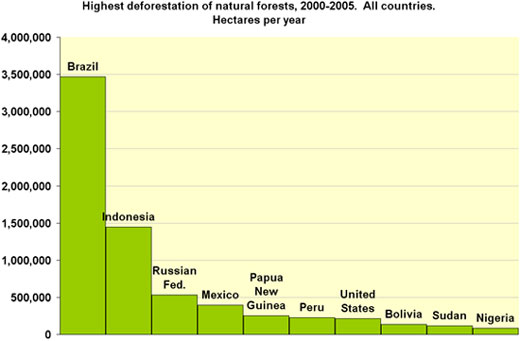
1/ I haven't exactly placed the US on the forest loss/preservation graph yet but I've found some recent, and very interesting, reports. Here are the links followed by some relevant statistics. I also re-read the Dinnerstein and Wikramanayake paper (D+W) (to see their exact criteria) and if you are interested it is a good read: Beyond Hotspots: How to Prioritize Investments to Conserve Biodiversity in the Indo-Pacific Region.

Useful Reports on Global Forest Resources and Deforestation
Statistics
  • Between 2000 and 2005, the United States lost an average of 215,200 hectares of "primary forest" per year. D+W extrapolated current rates of primary forest loss to give their estimated 10 year loss rate. This would give the US a predicted 10 year loss of 2.1 million hectares.
  • In absolute terms this gives the United States the seventh largest annual loss of primary forests in the world, ranking it the worst among wealthy countries. However in terms of % loss this change is less dramatic.
  • There are approximately 300 million hectares of forest in the US but only about 100 million of this is primary forest.
  • 6o million hectares of forest is protected for conservation in the US. If we assume that all this is primary forest then that leaves 40 million hectares of unprotected primary forest.

2/ Maybe I misspoke but I think the figures I gave on land surface area and conservation plans in Madagascar were correct.
  • Madagascar is 587,000 km2 or ~60 million hectares.
  • Currently about 1.8 million hectares are in reserves (about 5 million acres)
  • Plans are to triple this to over 5.5 million hectares (about 15 million acres) or about 10% of the land surface area.

Thursday, October 30, 2008

Tahoe-Baikal Institute

The Tahoe-Baikal Institute is pleased once again to offer our Summer Environmental Exchange (SEE) program at Lake Tahoe and Lake Baikal from June to August 2009. Each summer the SEE program brings together an international group of young environmental leaders to learn about and directly participate in watershed protection, sustainable economic development, and cross cultural exchange.

The 2009 exchange will mark the 19th consecutive SEE program. Many of our 300+ international “graduates” of the SEE and other TBI programs hold influential positions as natural resource managers, academics, NGO leaders, and stewards of international cooperation and understanding all over the world, including Lakes Tahoe and Baikal. For students or recent graduates interested in pursuing a career in natural resource management, international policy, or related fields, the SEE is a promising and rewarding summer opportunity!

Visit the website for more information. There you can find more detailed information about the SEE program itself and the application process.

Biodiesel - friend or foe?

I took a couple of the pictures in lecture today from an article in National Geographic this month entitled Borneo's Moment of Truth . The article is worth reading and raises some interesting points about conservation.

"Virgin rain forest is a dead concept now in Borneo," says Glen Reynolds, chief scientist at the Danum Valley Field Center in Sabah. "All of the big areas of primary lowland forest that can be conserved already have been. It's difficult, but now what you've got to do is convince people that what we think of as degraded forest can sustain biodiversity."

Don't overlook the photo gallery with the usual high quality National Geographic photography.

Wednesday, October 29, 2008

Ecological credit crunch

Feel free to chime in here but I suspect that most people don't understand the current financial crisis. They may know, or suspect, how it is going to influence them but at heart I think peoples' eyes glaze over when the experts start talking about derivatives. See? Half of you just stopped reading this post....

Anyhow it struck me that using the current global economic crisis as a metaphor for something else might not be the smartest move. But what do I know?

Anyhow, in the hews today:

A report by a number of leading conservation groups warns that unless prompt corrective measures are taken, the planet is heading toward an ecological credit crunch.

Midterm

We graded the midterm and will return it to you after class tomorrow. It's on a straight scale so >27/30 is an A, > 24/30 is a B and >21/30 is a C. Everybody passed and two people scored 30/30

Tuesday, October 28, 2008

Ivory For Sale, Legally (and Controversially)

Almost 20,000 pounds of elephant ivory went for sale in Namibia today.

Is this protecting the elephants from 9 years of future poaching? Is the revenue from the auctions really going to “be used exclusively for elephant conservation and community development programs within or adjacent to the elephant range,’’ as Cites says, according to today's New York times article? The Cites press release gives more info.

This sale is the first of four approved by the United Nations which will result in almost 240,000 pounds of Southern African ivory sold. What do you think of this way to manage a growing elephant population?

Monday, October 27, 2008

Wildlife Overpasses


This is an experts' rendering of a wildlife overpass. As you can see, all the animals are happily gridlocked in their corridor.
It seems as they forgot about this wonderful option
which is quite pretty with its stepping stones and such. I'm sure if they knew about it they would love crossing this gated-animal-community-garden-thing.

Midterm

No great revelations just a number of small clarifications and some small pieces of advice.
  • Please try to get to class promptly. You should have enough time but coming in late may disturb others.
  • Please turn off your phone.
  • You will not need a calculator, scantron or blue book. You will need a pen. A back up pen may be a good idea.
  • Please write legibly. The space provided for the answers is enough to provide a good answer but is deliberately limited to make you think carefully about exactly what you write. Use the space wisely.
  • In the longer questions you will generally do better if you make a number of points rather than making the same point a number of times.

Thoreau Is Rediscovered as a Climatologist

From today's New York Times:

Henry David Thoreau endorsed civil disobedience, opposed slavery and lived for two years in a hut in the woods here, an experience he described in “Walden.” Now he turns out to have another line in his résumé: climate researcher.

In 1851, when he started recording when and where plants flowered in Concord, he was making notes for a book on the seasons.

Now, though, researchers at Boston University and Harvard are using those notes to discern patterns of plant abundance and decline in Concord — and by extension, New England — and to link those patterns to changing climate.

Their conclusions are clear. On average, common species are flowering seven days earlier than they did in Thoreau’s day.

Sunday, October 26, 2008

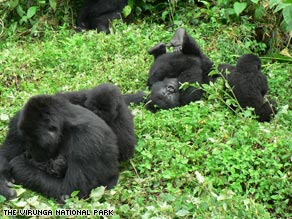
Congolese rebels seize gorilla park

I try quite hard not to make this course too depressing. I also try not to make the blog a non-stop parade of bad news. But sometimes it just keeps on coming. A headline today on CNN is 'Thousands flee fighting as Congo rebels seize gorilla park.'
Rebels have seized the headquarters of the Virunga National Park in the Eastern Congo. The 3,000 square mile park is home to 200 of the remaining 700 mountain gorillas. The 50 park rangers have been forced to flee.

This is the same park where seven gorillas were murdered last year. National Geographic covered this story in depth. Curiously this month's issue has a letter objecting to the use of the word murder in the gorilla story.

The continual conflict in the Congo has had a severe toll on wildlife in the region. In 2005 a survey by the World Wide Fund for Nature showed the population of hippopotamuses in Lake Edward in Virunga National Park's had plummeted to less than 900 individuals from an estimated 29,000.

The fighting in the Democratic Republic of the Congo is also a humanitarian crisis. Since 1998, and the start of the Second Congo War (also known as Africa's World War) over 5 million people have died. Although the second Congo war ended in 2003 this has not stopped the fighting or the deaths due to malnutrition and disease.